“Almajiris Are Not to Blame” – Hannah Hoechner, researcher, University of Oxford
Kano, National Politics, State News, Top Stories Wednesday, June 27th, 2012
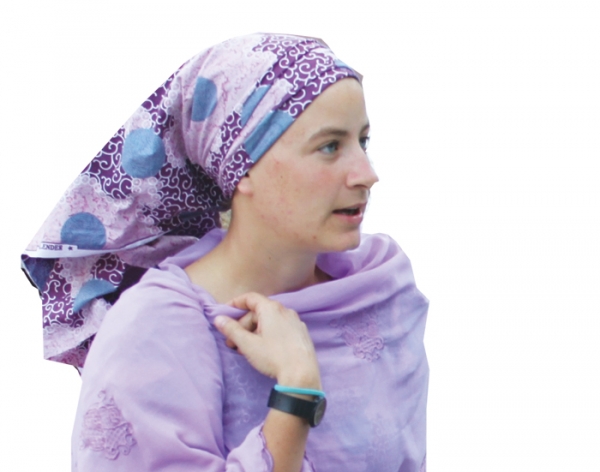
Hannah Hoechner, British researcher
They are often blamed for any and every social disturbance in the northern part of Nigeria. In fact, to many, the Almajiri are nothing but irritants. But Hannah Hoechner, a researcher from the University of Oxford, United Kingdom, UK, who spent a year in Kano working with the Almajiri, does not see them as such. Hoechner who studied International Relations and Development Studies in Dresden, Germany, and Oxford, UK, spent a better part of 2010 doing her doctorate research in Kano studying traditional Koranic schools. In this interview with Tundun Adeyemo, special correspondent, UK, she talks about her impressions of Kano and the Almajiri. Excerpts:
What led you to Kano in the first instance and how did you cope with the heat, mosquitoes and life out there generally?
I had always been passionate about children and youth issues and wanted to pursue a related topic in my master’s and doctoral research. I had spent some time in Senegal before coming to Nigeria. There I first came into contact with the traditional Koranic schooling system. It struck me how controversial and emotive the topic is, and how seldom the young people living as traditional Koranic students themselves are listened to – despite widespread concerns about them. I came to Kano because my supervisor at the time (Dr Masooda Bano) was doing some work for the DFID-funded Education Sector Support Programme in Nigeria, ESSPIN. By coming to Kano I could not only benefit from their logistical support but also cooperate with an agency interested in my findings and prepared to translate them into policy. As regards heat, mosquitoes, the wild traffic in Kano, the erratic electricity supply: one of the first things I was keen to learn from my friends in Kano was ‘hakuri’ – patience! I am still deeply impressed with the ability of the people of Kano to endure, and to have faith and hope for things to improve in the future.
Tell us a bit about your research. How well were you received? How do you think Kano State government can turn your research into policy?
The main motive behind my research is to understand the Almajiri-system from the point of view of its insiders. Why do parents opt to enrol their children as Almajiri? What kinds of experiences do young people living as Almajiri gain? What are their views and concerns? This wasn’t always an easy point to get across. Many people, especially, adults, presume to ‘know’ the reasons behind the system and what the lives of these children are like, but not many make the effort to actually listen to the young people themselves. I tried to let them speak for themselves as much as possible. Part of this endeavour was the production of a participatory film or docu-drama called Duniya Juyi Juyi in which nine Almajiri from three different schools re-enacted experiences they had while living as Almajiri in Kano. Other parts of my research involved spending four months in a rural area of Kano State (Albasu LG), teaching them modern subjects, spending time with and befriending them, also, their teachers, fathers, mothers, aunts and grandmothers. I also conducted numerous interviews with teachers, parents, and current and former Almajiri. My research sheds light on the conditions sustaining the Almajiri-system as well as the everyday concerns of the young people enrolled in it. Both areas lend themselves easily to policy interventions.
It is often thought that life in the North can be difficult and scary especially for a foreign woman. How were you able to carry out your research without limitations of language and gender?
I think who we are always matters simultaneously in both positive and negative ways for the kinds of insights we can gain. Being a modern-educated, non-Muslim woman and Hausa-learner, certain domains were clearly inaccessible to me. For example, I couldn’t participate in the Almajiri’s lessons that took place in a mosque. At the same time, certain domains became accessible to me precisely because of my identity.
Being a woman, I could spend as much time as I wanted with other women who often turned out to be better informants than men! As a non-Muslim, I was granted more freedom moving about public space and interacting with men. As a foreigner, I could get away more easily with inadvertent (or deliberate) cultural trespasses, for example, failing to pay requisite respect to age or class hierarchies. My mistakes and awkwardness in Hausa might have served to put respondents (many of whom were illiterate) at ease who otherwise might have felt intimidated by the difference in level of education between us.
What part of your research did you enjoy or dislike most?
One of the best moments of my research was the premiere of our film Duniya Juyi Juyi. The Goethe-Institute (that had supported the project) organised a big screening on their premises with over 300 spectators. After the film, we had a question and answer session with the audience. It was great to see the Almajiri involved in the filmmaking being treated by spectators and attendant politicians at eye level. They took them and the concerns they had illustrated in the film seriously, and interacted with them as equals in the discussion. That was what I had wanted to achieve with my research: to give a voice to the powerless to speak up for themselves and to compel respect for their perspectives and identities.
Accordingly, the worst moments of my research were when people didn’t consider my research to have any bearing on their realities, or when they felt inadequately compensated for their time and efforts by what I had to offer: that I would do my best to communicate their views to a larger audience. Being a researcher from a prestigious university in Europe carries all kinds of material expectations with it. I found it quite exhausting to rebut time and again misguided ideas about the vast resources I was presumably commanding.
The Almajiri have been linked to massacres, terrorism and radical Islamisation. In your opinion, would you agree that most of the Almajiri are vulnerable to these influences or noble to the true cause of Islam?
In my research I encountered neither the ‘gullible children’ nor the ‘angry youth’ ready to engage in sectarian or inter-religious violence as the Almajiri are often portrayed. The Almajiri I got to know well and became close to were resourceful and amiable young people. I guess the nature of anthropological research has it that researchers are more likely to defend than point fingers at their informants. Still I think there are some real problems related to the Almajiri-system that need to be addressed if one wants to rule out that young people become frustrated with, and eventually alienated from, mainstream society. First of all, what kinds of skills can current and former Almajiri acquire that will help them sustain themselves economically after school? The Almajiri I befriended longed for opportunities to learn or further their vocational skills and modern education. Secondly, is it possible for the Almajiri to conceive of themselves and their future positively? Being denigrated and denied respect was a huge concern for the Almajiri I got to know well. They were going out of their way to defy negative representations of them as hoodlums and rogues, and struggled to maintain a positive self-image as devoted seekers of sacred knowledge and character development. A rhetoric that puts the blame on the Almajiri for anything and everything may well frustrate and alienate them. A better approach would be to ask why some young people can’t pursue the education they would like to pursue, and why there are so few jobs available even for those who manage to acquire modern education. This inevitably leads to questions about poverty and the unequal distribution of wealth in Africa’s oil-richest country.
When you talk about the sadness of some of the Almajiri you spoke to who having started some sort of primary education, but left it off to join the Almajiri system, would you agree or disagree that these children are not entirely against Western education?
In most cases it is not the children themselves who take decisions about their education, but their parents. Most if not all of the Almajiri I met valued modern education and aspired to acquire it in the future. Former Almajiri make up a large part of the clientele of adult evening schools in Kano, it seems.
What do you make of the federal government’s decision to build schools for the Almajiri?
It’s certainly a step in the right direction. Questions that arise are however: how many students will these schools be able to cater for, and what happens to the rest? It is estimated that some 300,000 young people live as Almajiri in Kano State alone! How will the children to attend these schools be selected? How can we ensure that the poorest of the poor are reached by such initiatives?
You were in Kano for over a year; did you get a taste of Sharia law in practice? What are your thoughts about Sharia law?
As any other social order, Sharia is always the product of the social and political conditions in which it is practiced. How it is experienced in everyday life is highly contingent on contextual factors. For example, Sharia law gives women a number of rights in the case of divorce. However, many women in rural Kano don’t know these rights, nor do they have the means to pursue their claims in court. Thus the empowering potential of Sharia cannot be realised.
Would you return to Kano State on holiday or perhaps for another study?
I would certainly love to see the people I grew close to in Kano again as soon as possible, especially as the sad recent developments in Kano – the bombings of January 20 and continued attacks on the police since – leave me worrying how they are doing. After a German national was taken hostage in Kano and the hostages taken in Birnin Kebbi in May 2011 were killed, I suppose though that my university (and family) would object to me visiting Kano at the moment. At least now that more people have mobile phones, it has become easier to stay in touch even over the distance. If the government finally does something about the erratic electricity supply in Kano, there is even hope that their phones may be charged.
-Tell magazinewp_posts
Related Posts
- 2027: Tinubu worst President ever, North finished if he wins again – Baba-Ahmed
- Nigeria not a Muslim country – Rev Dachomo counters Sheikh Jingir
- Why we planned coup against Tinubu – Colonel Ma’aji, without legal counsel
- Davido calls on Trump, international community to monitor Osun election
- Osun Election: ‘Oyinlola jealous of me and my family’ – Gov Adeleke


Short URL: https://newnigerianpolitics.com/?p=22526


 Posted by admin
on Jun 27 2012. Filed under Kano, National Politics, State News, Top Stories.
You can follow any responses to this entry through the RSS 2.0.
You can leave a response or trackback to this entry
Posted by admin
on Jun 27 2012. Filed under Kano, National Politics, State News, Top Stories.
You can follow any responses to this entry through the RSS 2.0.
You can leave a response or trackback to this entry