Disturbing Picture: Osama Bin Laden’s bullet ridden body
Africa & World Politics, Headlines Monday, May 2nd, 2011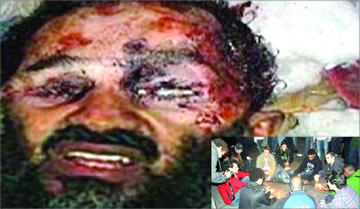 The al-Qaeda leader, Osama Bin Laden was found and killed at a fortified compound
on the outskirts of Abbottabad in north-west Pakistan, the British Broadcasting Corporation (BBC) has reported.
According to the report, the compound where he was killed was a few hundred metres from the Pakistan Military Academy, an elite military training centre, which is being described as Pakistan’s equivalent to Britain’s Sandhurst or the West Point academny in the US.
However, there were conflicting reports about the compound’s distance from the academy, with Pakistan’s military saying they are as much as 4 kilometers (2.4 miles) apart.
“In any case the compound lies well within Abbottabad’s military cantonment, and it is likely the area would have had a constant and significant military presence and checkpoints.
“Pakistan’s army chief is a regular visitor to the academy, where he attends graduation parades.
“The operation against Osama Bin Laden began at about 2230 (1730 GMT) and lasted about 45 minutes, military sources told BBC. Two or three helicopters were seen flying low over the area. Witnesses say they caused panic among local residents.
When the helicopters landed outside, men emerged from the aircraft. The raid was conducted by a special team of US Navy Seals.
People living in the area, known as Thanda Choha, told BBC that they were commanded in Pashto to switch off their lights and not to leave their homes.
Shortly afterwards residents said they heard shots being fired and the sound of heavy firearms.
At some point in the operation, one of the helicopters crashed, either from technical failure or having been hit by gunfire from the ground.
The compound was about 3,000 sq yds in size but people from the area told the BBC that it was surrounded by 14ft-high walls, so not much could be seen of what was happening inside.
The walls were topped by barbed wire and contained cameras.
There were two security gates at the house and no phone or internet lines running into the compound.
‘Waziristan Mansion’
After the operation witnesses said all they could see was fire snaking up from inside the house.
Osama Bin Laden did resist the assault and was killed in battle, US officials told White House reporters.
The officials described the operation as a “surgical raid” and said three adult males, including Bin Laden’s adult son, were killed. But, they added, a woman who was being used as a shield was also killed.
According to local residents speaking to BBC the forces conducting the operation later emerged from the compound, possibly with somebody who had been inside.
They said that women and children were also living in the compound.
One local resident told the BBC that the house had been built by a Pashtun man about 10 or 12 years ago. The resident said that none of the locals were aware of who was really living there. However, the New York Times said US officials believed that the house was specially built in 2005.
According to one local journalist, the house was known in the area as Waziristani Haveli – or Waziristan Mansion.
The journalist said it was owned by people from Waziristan, the mountainous and inhospitable semi-autonomous tribal area close to the Afghan border, which until now most observers believed to be Bin Laden’s hiding place.
This house was in a residential district of Abbottabad’s suburbs called Bilal Town and known to be home to a number of retired military officers from the area.
Intelligence officials in the US are quoted by AP as saying that the house was custom-built to harbour a major “terrorist” figure.
‘Trusted’ courier
Police walk past the compound where the battle took place.
As details of the raid emerged it became clear that the operation had been long in the planning. US officials said they received intelligence that Osama Bin Laden might be in that compound as long ago as last summer.
CIA experts analysed whether the “high value target” living at the compound could be anyone else but they decided in the end that it was almost certainly Bin Laden.
US intelligence agents focussed in particular on one of Bin Laden’s couriers – a man identified as a protege of captured al-Qaeda commander Khalid Sheikh Mohammed.
He appeared to be one of the few couriers completely trusted by Osama Bin Laden, who helped keep the al-Qaeda figurehead in touch with the rest of the world.
For years US intelligence had been unable to name the courier. But four years ago they worked out who he was and two years later they discovered where he operated.
It was only in August 2010 that they located him in Abbottabad, Pakistan.
US officials described as “extraordinary” the security measures in the Abbottabad compound – among them high walls and barricades, very few windows, and a 7ft high privacy wall on the second floor.
After the US attack Pakistani troops arrived at the scene and began securing the area.
Celebrations as US forces kill Osama bin Laden •DNA confirms his death
PEOPLE in the United States and other parts of the world celebrated the death of al-Qaeda chief, Osama bin Laden, on Monday, after President Barack Obama announced he was killed by the US military after a decade-long hunt to avenge the 9/11 attacks.
The Obama administration used DNA testing and other means to confirm that elite American forces in Pakistan, in fact, killed Osama bin Laden, the mastermind behind the September 11, 2001 terrorist attacks, officials said, on Monday, as the world absorbed the stunning news.
The officials said the DNA testing alone offered a “99.9 per cent” certainty that bin Laden was shot dead in a daring US military operation in Pakistan. Detailed photo analysis by the CIA, confirmation by other people at the raid site and matching physical features like bin Laden’s height all helped confirmed the identification.
Said one official: “There should be no doubt in anybody’s mind, this is Osama bin Laden.”
The officials spoke on condition of anonymity given the sensitivity of the matter.
Still, it was unclear if the world would ever get visual proof. Bin Laden’s body was quickly buried at seat, and administration officials were weighing the merit and appropriateness of releasing a photo of bin Laden, who was shot in the head.
The 54-year-old leader of Al-Qaeda was dramatically killed, on Sunday, in a firefight with American special forces in a $1million mansion hideout around 60 miles north of Islamabad in Pakistan.
US officials reportedly told broadcaster CNN that Bin Laden’s body was buried at sea in order to prevent the grave from becoming a shrine for extremists.
In a dramatic statement, late on Sunday night, Obama said the US military had recovered the body and confirmed to the world he had finally been killed.
“Tonight I can report to the American people and the world that United States has conducted an operation that killed Osama Bin Laden, the leader of Al-Qaeda and a terrorist who is responsible for the murder of thousands of innocent men, women and children,” he said.
“Justice has been done”.
Officials said the body would be handled according to Islamic practice and tradition. That practice called for the body to be buried within 24 hours.
Within minutes of the news breaking Americans began gathering outside the White House to sing the national anthem and chant: ‘USA! USA!’
In a spontaneous outpouring of emotion, thousands started cheering and clapping and waving American flags to show their support.
Large groups of Americans gathered outside the White House in Washington and at ‘ground zero’ in New York to celebrate the news.
Paul Lagrandier, a retired New York firefighter who was part of the rescue for September 11 said he felt mixed emotions.
He told MailOnline: “I’m saddened for the people who were affected by the tragedy and have to go through all this again.”
When asked what he thought about why it took so long to track down the terrorist, he said, “I just knew we were working at it and we kept working at it. They stayed the course and accomplished the mission.”
But the terror chief’s death will undoubtedly put the Middle East on high alert for reprisal attacks. It will also lead to urgent demands from Washington as to how the most wanted man was allowed to seek refuge in a supposedly allied country as Pakistan.
US military sources revealed, on Sun night that Bin Laden had been taken by surprise by the attack by a small team of US Navy Seals who landed in the grounds of the compound.
He had been living at the luxury home with his youngest wife, Amal al-Sadah.
During an operation in which troops were on the ground for just 40 minutes, they stormed the terror chief’s hideaway.
Four helicopters took part in the attack on Bin Laden’s two-storey house, which was understood to be within 100 yards of a military building in Abbottabad, a garrison town which is home to thousands of Pakistani troops.
According to Pakistani officials in the town, fighters on the roof opened fire with rocket propelled grenades as the aircraft came close to the building. Pakistani officials and local people said one of the helicopters crashed.
In a dramatic finale, it is said that Bin Laden was offered the chance to surrender. But the leader, who had always said he would not be captured alive, refused and was blasted in the head by troops.
Three of the terror leader’s men, including his own son, were also killed in the raid alongside a woman. They reportedly tried to act as a human shield in a furious firefight.
US troops returned to the damaged helicopter, but they were forced to carry Bin Laden’s body to a working aircraft.
Pictures showing a bloodied face were later played on Pakistani TV. The beard and hair are both noticeably darker than they have appeared to be in previous videos of Bin Laden, and there were later suggestions that the picture had been been faked.
In his televised statement Mr Obama said that Bin Laden was killed in a helicopter raid by a small group of US Navy Seals who stormed his mansion in an affluent area 80 miles from Islamabad.
They were working on a tip which first surfaced last August after “years of painstaking work” from the CIA and had taken months to run it into the ground.
“Last week I determined that we had enough intelligence to take action and authorised an operation to get Osama Bin Laden and bring him to justice,” Mr Obama said.
6 children, 2 wives of Bin Laden arrested in Pakistan
Meanwhile, LOCAL Urdu TV channel, Duniya, quoted sources as saying that six children, two wives of Osama Bin Laden were arrested along with his four close friends in a search operation launched, early on Monday morning, by the Pakistani forces in a mountainous area located some 60 kilometres north of Pakistan’s capital Islamabad.
The report said that one of Bin Laden’s sons was killed in the operation.
Cameron, others react to news of Bin Laden’s death
EUPHORIA over the killing of September 11 mastermind, Osama bin Laden, was tempered in the West, on Monday, by fears of retaliation, and world leaders and security experts urged renewed vigilance against attacks.
Americans celebrated on the streets and United States markets rallied on hopes bin Laden’s death could ease the threats hanging over much of the developed world — but even President Barack Obama said that terrorist attacks would continue to be a concern.
French president, Nicolas Sarkozy, hailed the killing as a coup in the fight against terrorism, but both he and foreign minister, Alain Juppe, warned it did not spell al- Qaeda’s demise.
British prime minster, David Cameron, also said the West would have to be “particularly vigilant” in the weeks ahead.
As he announced Bin Laden’s death, Obama said: “There’s no doubt that al-Qaeda will continue to pursue attacks against us. We must and we will remain vigilant at home and abroad.”
Some security experts feared the 10th anniversary of the September 11 attacks could further incite al-Qaeda supporters.
“Whilst we in the West might have the satisfaction of justice having been dealt to a terrorist, many will still see Osama bin Laden as a martyr.
Make no mistake: violent jihadists will react to this,” Julian Lindley-French of London’s Chatham House think-tank told Reuters Insider television.
Roland Jacquard, head of the International Terrorism Observatory in Paris, said the United States would be targeted.
“The way in which he was killed, by a military commando, shows this will have important consequences for the future. It will be a call for Jihad, he will remain a very real-life martyr for the rest of the organisation,” Jacquard told RTL radio.
Already on Monday, Islamic militants hinted at revenge.
“Oh God, please make this news not true… God curse you Obama,” said one message on an Arabic language forum. “Oh Americans… it is still legal for us to cut your necks.”
Osama’s death to boost Obama’s re-election bid
AFTER United States president, Barack Obama, announced that Al-Qaeda leader, Osama bin Laden, was killed by US forces in Pakistan, on Monday, Americans trooped to the streets in celebration of his death.
The death of the Saudi Arabia-born fugitive is expected to boost Obama’s re-election bid. Bin Laden’s death is likely to engineer a shift of attention from Obama’s certificate controversy apart from rattling the Republican camp, which has been struggling to find a credible candidate to confront Obama in next year’s presidential race.
Serving and former world leaders, including Obama’s predecessor, George W. Bush, British prime minister, David Cameron, Afghan president, Hamid Karzai and Israeli prime minister, Benjamin Netanyahu, among others, lauded Obama’s successful elimination of the the brains behind the September 11, 2001, bombings that killed about 3,000 people.
His Israeli counterpart said it represented “triumph for justice, freedom and the values shared by all democratic nations fighting shoulder to shoulder in determination against terrorism.”
Obama’s many options of killing Osama Bin Laden
President Obama had several options for assassinating Osama bin Laden, but he did not let preference for one or the other to delay an attack, an administration official told The Huffington Post.
The morning after covert U.S. forces killed bin Laden in a compound Abbottabad, Pakistan, ABC News reported that Obama had passed on a chance to bomb that same compound back in March.
According to the report, the president was wary of attacking the location with two B-2 stealth bombers out of concern that it would reduce the building (and all evidence inside) to rubble.
The potential for collateral damage — 22 people were inside the compound, including women and children — was also a deterrent, ABC News reported.
An administration source did not refute that such an operation was conceived and scrapped.
It was also reported on Monday that the “original plan for the raid was to bomb the house, but President Obama ultimately decided against that..”
The official did, however, push back against the notion (which could be inferred from either piece) that the president had a chance to kill bin Laden and didn’t pull the trigger.
“It’s wrong to say it was delayed because of a decision by Obama,” the official said. “They were constantly revising the intelligence and military planning until it was finally ready.”
In addition to being potentially destructive of both evidence and civilian life, attacking the compound with B-2 stealth bombers was also determined to be operationally risky.
The president and his team, instead, asked that the plan be revised to allow for a Navy SEALs unit to be transported in via helicopter.
Training for that took time. The Navy SEALs unit “replicated the one-acre compound at Camp Alpha, a segregated section of Bagram Air Base.
Trial runs were held in early April,” Marc Ambinder of the National Journal reported.
Global terror threat remains high -Interpol
Interpol member countries should take extra vigilance against retaliation after the killing of Osama bin Laden, the France-based international police organisation warned on Monday in a statement.
In the statement posted on the organisation’s website, the head of Interpol Ronald K. Noble called Bin Laden’s death “a fitting end to a symbol, advocate and sponsor of terrorism globally whose actions resulted in the murder of thousands of innocent victims in the U.S. and throughout the world.”
Following congratulations issued to the United States and its counterparts working together in operation killing the al-Qaida leader in Pakistan, the organisation also warned of still-high terror threat.
Kenya steps up security after Bin Laden’s killing
THE Kenyan government said Monday its security forces have stepped up security along the borders and all entry points for possible revenge attacks following the killing of Osama bin Laden.
Internal Security Permanent Secretary Francis Kimemia said security there is being stepped up particularly along the border with neighboring Somalia where al Qaeda-linked fighters are waging an insurgency to avert reprisals.
“We have put our security forces on very high alert to ensure that nothing happens. I think the United States should not stop there,” Kimemia said. “They (America) should go ahead and decimate all the cells, all the al Qaeda cells, some of whom are even nearby, near our country, ” he said.
Prime Minister Raila Odinga had earlier said the killing was a major achievement and justice too for Kenyan victims.
He said it was major achievement of the war on terror. “We welcome this,” he noted.
What Bin Laden’s death means for al-Qaeda
WHY now? It had been nearly a decade since 9/11. Almost until the moment the historic news of Osama bin Laden’s death was announced by President Obama, on Sunday night, United States and Pakistani intelligence officials had been saying publicly that the trail of the al-Qaeda leader was cold and had been so for years. Some experts suggested that it was possible that he would never be found, that bin Laden could end up like Mirza Ali Khan, the notorious “Fakir of Ipi” who was relentlessly hunted by the British in the 1930s and ’40s but simply disappeared into the folds of what are now the Pakistani tribal regions.
Moreover, US-Pakistani relations had been even rockier than usual lately. Pakistani authorities complained bitterly about the extent of US operations inside their country after a Central Intelligence Agency (CIA) contractor, Raymond Davis, killed two Pakistanis who had allegedly attempted to rob him in Lahore in late January.
But the president, in his statement to the nation, said that as far back as August of 2010, he had been briefed on “a possible lead” about bin Laden’s whereabouts. It wasn’t until last week, Obama said, that “we had enough intelligence to take action.” On Sunday he authorised a covert US operation at a compound where bin Laden was holed up in the northwest town of Abbottabad, less than 50 miles north of the Pakistani capital of Islamabad. Obama credited the “counterterrorism cooperation with Pakistan [that] helped lead us to Bin Laden.”
As welcome as the news was, it raised more questions than it answered. The location of bin Laden’s last hideaway, for one thing, is significant.
It turned out he had long ago left the “caves” he was putatively hiding in; instead, he was living in a relatively affluent city that is close not only to Pakistan’s political power center but to the living quarters of its top military officer corps. The news was a significant embarrassment to Pakistani authorities, who had maintained for years that they had no idea where bin Laden was.
So one question is, does this mark a new level of cooperation with Pakistan that will help solve one of the most difficult challenges in completing the task of eradicating al-Qaeda and its affiliates? US military experts feared that the safe haven enjoyed by Islamist radicals affiliated with al-Qaeda in Pakistan, next door to the nearly 100,000 troops fighting in Afghanistan, was a nearly insuperable problem. One of them, Army Colonel T.X. Hammes, a counterinsurgency expert, told National Journal recently that the Pakistan problem was far worse than the challenge US forces had faced in dealing with the insurgency in Iraq, which had benefited from open borders with Syria and Saudi Arabia.
A US official with knowledge of the operation told National Journal, on Monday, that Pakistani help was very limited, that “this was a CIA operation” from the start. The official also said that the operation was years in the making, beginning with information gleaned from detainees who “flagged to us people who had been helping bin Laden. One was a courier whose name kept coming up. But he had a nom de guerre.
Then, four years ago, we uncovered his name. Two years ago we finally identified the areas where he and his brother were operating. Then, in August 2010, we found this residence. But it was eight times larger than others in the area, and this courier and his brother had no identifiable means of income.” Most of the details were kept secret from the Pakistanis. “No one had advance knowledge of the operation,” said the official, who would give details of the case only on condition of anonymity. “It was a huge intelligence puzzle, with pieces put together along the way. There were just bits and pieces of information, that’s how I would view Pakistani help.”
If US forces were in fact acting in cooperation with Pakistani officials, there is ample reason to be suspicious of how helpful they will be in the future. Given the recent rift in USPakistani relations, this event could well follow an old pattern in which the Pakistanis abruptly provide useful intelligence in order to blunt antagonism from Washington that could jeopardize billions of dollars in aid, and then fall silent again. “How many times have we killed al-Qaida’s No. 3″ in Pakistan? John Arquilla, an intelligence expert at the Naval Postgraduate School in Monterey, California, told National Journal, early on Monday. “Twenty times?”
The much larger question, of course, is what happens now to al-Qaeda? Is the “long war” against terrorism really over? Undoubtedly, the death of a leader who had attained nearly mythological stature over the past two decades is a great symbolic victory for the United States and its allies. But many intelligence experts believe it has been some time since bin Laden had been directly in control of al-Qaeda operations. Reliable reports in 2007 indicated that there was even a split between bin Laden and his chief deputy, Ayman al-Zawahiri, and that the latter was running operations.
In subsequent years, al-Qaeda has become a far less centralised movement. It has relied on free-lance radicals who had become deft at using the Internet, among them Anwar al Awlaki, the radical cleric who is believed to be hiding in Yemen. Only a year ago, on May 1, 2010, a Pakistani expatriate named Faisal Shahzad, allegedly acting largely on his own, had sought to detonate a car bomb in Times Square, a plot that was only narrowly averted. Meanwhile, anti-US sentiment continues to rage out of control in Pakistan and many Arab countries, fed by Obama’s aggressive prosecution of the war in Afghanistan and Pakistan as well as his decision to break a promise to close down the Guantanamo Bay prison camp.
“I was disturbed to hear people say al-Qaeda was finished. That’s a lot of bunk. The movement goes on,” says Arquilla. “al-Qaeda has lost a leader and gained a martyr. How does that cut in terms of recruitment and in terms of the narrative?”
Still, coming at the same time as democratic upheaval in the Arab world has offered another means of self-expression for young Muslims who had once found an outlet only in Islamism, the loss of bin Laden could begin to drain the movement of its energy.
Beyond that, until Sunday bin Laden was thought to have been the best-protected terrorist in the world, and the message to other terrorists is clear: if the United States can get him, it can get you. Indeed, the dimensions of this intelligence and military success are extraordinary. The last time that bin Laden’s whereabouts were said to be definitively known was late 2001, scarcely two months after 9/11. Gary Berntsen, the CIA officer in charge of the Afghan operation, said that that bin Laden was trapped in al-Qaeda’s Tora Bora hideaway after the fall of Afghanistan’s Taliban rulers in late 2001. As Berntsen recorded in his 2005 book “Jawbreaker,” bin Laden told his followers, “Forgive me,” and apologised for getting them pinned down by the Americans.
But the Pentagon refused to put in the necessary troops, Bernsten said, and bin Laden disappeared. For years afterwards there was almost no sign of him, beyond occasional rumours. It was said Islamist radicals had boasted that bin Laden was so well protected by the Pashtun tribes of Pakistan that even those closest to him didn’t know where he spent the night. He had long ago given up using electronic communications, relying on anonymous couriers through a series of buffers, and his meetings with trusted aides were said to be held outside his base. Now that myth of invulnerability is destroyed.
Above all, bin Laden’s death is a repudiation, to some degree, of the radical narrative he had sought to sell to his sympathisers around the world: that by launching a long, draining war on many fronts, he would weaken America just as the mujahedeen in Afghanistan did to the Soviet Union. For many years, as the United States launched one war after another and suffered a financial and economic crisis, that nightmarish vision appeared to be coming true. But now we know that bin Laden won’t live to see it succeed.
Osama Bin Laden’s death: End of world terror?
SINCE the news of the death of world’s most wanted terrorist, Osama Bin Laden was broken to the world by United States’ President Barack Obama Sunday night, analysts have expressed mixed feeling whether his death was the end of world terror.
One of these analysts, a political scientist, an expert in international relations and security studies and acting Head of Department of Political Science, University of Ibadan, Dr Osisioma Nwolise, said Bin Laden’s demise “may not mean the end of world terror.”
President Obama, while addressing the world on Bin Laden’s death had announced Sunday night that “al-Qaeda mastermind, Osama Bin Laden, has been killed by US military operation and is confirmed dead.”
Even with the confirmation by the US president, Nwolise, speaking with Nigerian Tribune said with Bin Laden’s inherited wealth estimated to worth millions of dollars, he would have built a network of allies which would take over the struggle after him.
According to him, the world terror was not about Osama Bin Laden alone, because he too ideologically joined the struggle, and because of his enormous wealth, he got entrenched in his fight against the Western powers and quickly became the cynosure of all eyes.
He said there were a lot of questions to ask the US government which had courted Bin Laden’s friendship during the cold war era before things later turned sour between them.
“The Americans need to tell us why the honeymoon between them and Osama turned sour immediately after the could war between them and the Soviet Union.
“We need to know what happened. There are issues to be sorted out before we know if Osama’s death is the end to global terror.
“Osama joined a struggle which he ideologically identified with. So it is not only a question of Obama’s death marking the end of world terror, but what happens to the terror network he has built with his wealth worth millions of dollars?
“The US used Osama to achieve its aim during the cold war but has not told the world what went wrong with its relationship with Osama after the cold war. What happened to the honeymoon between them?
“It is also a question of justice between Osama and his group. We need to know what happened after which we can say if it is the end to global terror,” Nwolise said.
Bin Laden, until his death on Sunday, May 1, was the founder and leader of the al-Qaeda terror group. He was a Saudi-born multimillionaire and reportedly had at least three wives and more than 20 children.
He was born in Jeddah, Saudi Arabia, in 1957 as the 17th child of his father. His father was a Saudi Arabian construction tycoon whose family reportedly dominated housing and civil engineering in Saudi Arabia before Osama took over his family’s fortune after his father death.
Prior to this period, he was trained as a civil engineer in Jeddah and with his father’s business; he became a giant in the construction sector with an estimated personal fortune of US$400 million.
His link with the United States and the Western world began in 1979 when he joined the United States’ force against Soviet Union’s occupation of Afghanistan, an operation he termed a “Holy War” a Jihad against the Soviet forces.
His operations at this period were fully supported by the US and it was this struggle which made him to form the “al-Qaeda” military base camp and training centre in Afghanistan in 1988.
However, after the Soviet troops pulled out of Afghanistan in 1989, Bin Laden moved to Saudi Arabia and left in 1990 for Yemen.
He left the Arabian country in protest against Saudi Arabia’s action of welcoming the US troops into the country to attack Iraq forces in the Gulf War and later visited Sudan, the Africa’s largest country, in the northeast of the continent and south of Egypt.
It was during this period he developed hatred for Americans and its allies, especially the Israelis.
In 1994, Osama was stripped of his Saudi citizenship “for allegedly channelling funds for terrorism activities” and since then, he relocated to Afghanistan where he stayed until his death.
Throughout his stay in Afghanistan, Osama pulled together a lot of Islamic extremist organisations from different countries and regions and with his al-Qaeda network, he campaigned against Americans and its Israeli allied forces and staged a “war” aimed at driving Americans and Israelis out of Arab territories.
By 1995, Osama’s hatred for American and its allies had grown so much that he began to attack their embassies and in 1996, he was blamed by the United States for bomb attacks on US barracks in Dhahran, Saudi Arabia.
Also in 1998, he was accused of the bombing of American embassies in Kenya and Tanzania and on a US warship in Yemen in 2000, but Osama denied involvement in any of the attacks.
Before the Yemeni attack, in 1999, Osama had already been enlisted on the US wanted list of terrorists with a reward of US$5 million.
Two years later, precisely on September 11, 2001, the US branded Osama as the “prime suspect” behind the bombing of the World Trade Centre (WTC) in the United States.
He was declared wanted “dead or alive” by US government, with a ransom of $25 million for anyone with information leading to his arrest.
After this declaration, the United States stormed Osama’s al-Qaeda network and the Talibans’, its accomplices and host in Afghanistan 2001 but Osama’s hideout was not found.
Bush congratulates Obama on his killing
FORMER United States president, George W. Bush, congratulated President Batack Obama and the members of the military after learning that the US has successfully killed Usama bin Laden.
“This momentous achievement marks a victory for America, for people who seek peace around the world, and for all those who lost loved ones on September 11, 2001,” Bush said in a statement.
“The fight against terror goes on, but tonight America has sent an unmistakable message: No matter how long it takes, justice will be done.”
A number of politicians released statements heralding the effort and Obama’s handling of the strike. All praised the relentless pursuit by the US military and the actions taken by the intelligence community.
US House of Representaives speaker, John Boehner, said, “I want to congratulate — and thank — the hard-working men and women of our Armed Forces and intelligence community for their tireless efforts and perseverance that led to this success. I also want to commend President Obama and his team, as well as President Bush, for all of their efforts to bring Osama bin Laden to justice.”
Former secretary of state, Condoleezza Rice, called Bin Laden’s killing a “tremendous victory” and thanked the military and intelligence community for their skill and dedication.
“Nothing can bring back Bin Laden’s innocent victims, but perhaps this can help salve the wounds of their loved ones,” she said in a statement.
Democratic leader, Nancy Pelosi, called the killing a “significant development in our fight against Al-Qaeda.”
“I salute President Obama, his national security team, Director Panetta, our men and women in the intelligence community and military, and other nations who supported this effort for their leadership in achieving this major accomplishment,” she said in a statement.
-Tribunewp_posts
Related Posts
- 2027: Tinubu worst President ever, North finished if he wins again – Baba-Ahmed
- Nigeria not a Muslim country – Rev Dachomo counters Sheikh Jingir
- Why we planned coup against Tinubu – Colonel Ma’aji, without legal counsel
- Davido calls on Trump, international community to monitor Osun election
- Osun Election: ‘Oyinlola jealous of me and my family’ – Gov Adeleke


Short URL: https://newnigerianpolitics.com/?p=7834


 Posted by admin
on May 2 2011. Filed under Africa & World Politics, Headlines.
You can follow any responses to this entry through the RSS 2.0.
You can leave a response or trackback to this entry
Posted by admin
on May 2 2011. Filed under Africa & World Politics, Headlines.
You can follow any responses to this entry through the RSS 2.0.
You can leave a response or trackback to this entry



It’s surprisingly foreseeable that a lot of the celebrating Bin Laden’s demise can also be so delusional they can be stating such things as, “America is the freest country on earth.” Cost of 9/11? Several hundred thousand tops. Price of searching for Bin Laden? We are bankrupt. That was his primary goal. In death, he is still successful.